Jacksonville interior designer Emily Cornaire shares the lessons years of kitchen renovation projects have taught her, from layout planning and material selections to the details Florida homeowners should consider before getting started.
What I’ve Learned Designing Kitchens in Jacksonville Homes
There comes a point in almost every kitchen renovation when a client stops, looks at the drawings, samples, finishes, and notes spread across the table, and says, “I had no idea there would be this many decisions.”
I always tell them that kitchens are like weddings. It doesn’t matter how large or intimate the occasion — the same choices still have to be made.
A kitchen renovation is never just a construction project. It is one of the most personal investments you can make in your home. When each decision is made with care, the finished space does more than look beautiful. It works for the way you actually live, reflects your taste with intention, and feels completely, unmistakably your own.
My name is Emily Cornaire, and I am an interior designer based in Jacksonville, Florida. Over the years, I have had the privilege of designing kitchens throughout Northeast Florida, from century-old San Marco bungalows with original details worth preserving to bright, open-concept new builds in some of the area’s fastest-growing neighborhoods.
Every project has taught me something different.
The following is a collection of those lessons: practical, experience-based insights that rarely appear in a showroom brochure, along with questions I believe every Jacksonville homeowner should ask before ordering the first tile.
The First Thing to Get Right: Your Layout
Before you fall in love with a countertop, cabinet finish, or backsplash tile, the layout deserves your full attention.
This foundation supports the entire kitchen, and homeowners often move past this too quickly.
In Jacksonville, I see a few layout challenges again and again. In older neighborhoods such as San Marco, Avondale, and Riverside, designers often planned kitchens for a different era. They tend to be more compartmentalized and less connected to the way families live today. Most of my clients want those walls opened up. Thoughtful removal of those walls benefits the entire home.
Newer construction in areas like Nocatee and Ponte Vedra presents a unique challenge. These homes often have generous open-plan kitchens, but more square footage does not always mean better functionality. A kitchen can look spacious and still feel awkward to use.
The relationship between the refrigerator, sink, and stove — often called the work triangle — still matters. Placing those elements with intention makes cooking feel natural. When they are not, even the most beautiful kitchen can become frustrating.
That is why I devote a significant portion of the first client conversation to inquiring about the actual use of the kitchen.
Do you cook elaborate meals, or do you mostly reheat and assemble? Do you entertain often? Do children do homework at the island? Is the kitchen where everyone gathers?
The answers to those questions quietly shape every decision that follows.
What Finishes Actually Work in Florida Homes
Jacksonville’s climate plays a real role in material selection, and it deserves honest consideration.
Humidity is constant. Heat is intense. Sunlight can be strong and direct. What looks beautiful in a European design editorial may not perform the same way, or even feel the same, inside a Northeast Florida home.
A few things I have come to rely on:
Quartz over marble for countertops — in most cases.
I have a deep appreciation for marble, and I do specify it for clients who understand and embrace the upkeep. It has a softness and movement that is hard to replicate.
But for a busy Jacksonville family kitchen, quartz is often the better fit. It offers visual warmth, a wide range of styles, and much stronger durability in a humid climate.
A waterfall quartz island, in particular, can completely change the feel of a kitchen. It gives the room a sense of structure, polish, and permanence. The visual impact is hard to overstate.
Warm wood tones belong here.
Florida light has a warmth to it, especially in the late afternoon when it turns golden and low. White oak, walnut, and thoughtfully stained maple respond beautifully to that kind of light. The grain becomes more noticeable, the tones feel richer, and the whole room takes on a grounded quality that is hard to create with cooler materials.
Cooler tones can sometimes feel flat in Jacksonville homes, and in certain spaces, even a little sterile. Warm wood brings something different. It gives the kitchen a sense of depth and permanence, as if the design belongs to the home rather than simply following a trend.
That said, the all-white kitchen has remained popular for a reason. In a climate shaped by heat and humidity, a well-designed white kitchen can feel crisp, clean, and genuinely refreshing. For clients who want their kitchen to feel like a retreat from the Florida summer, white is still a beautiful and practical choice.
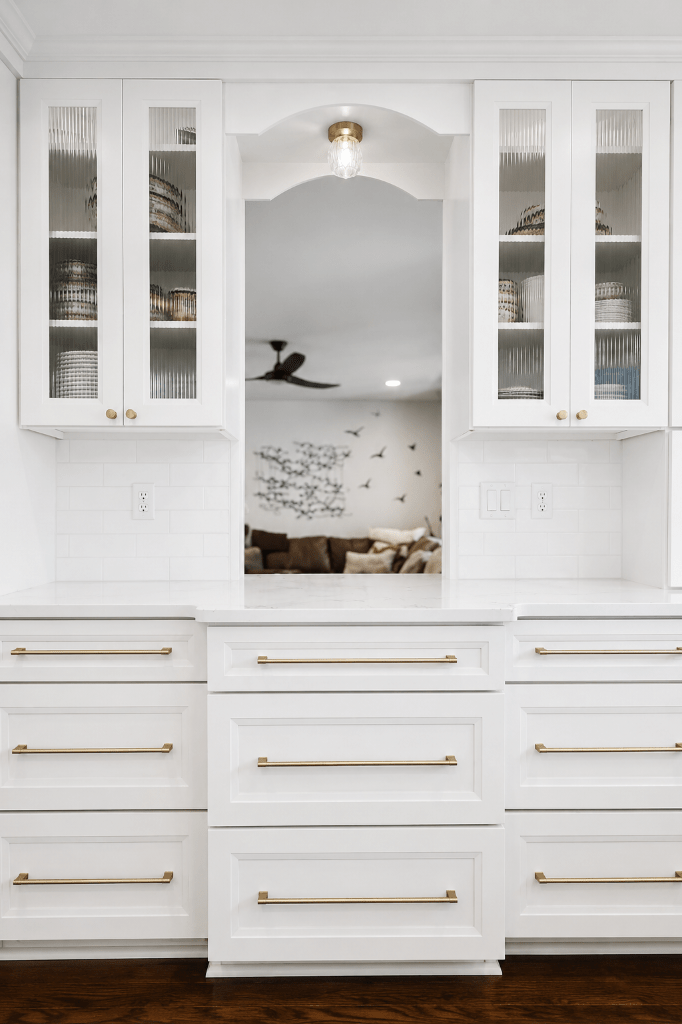
Where the design becomes especially interesting is in the mix. White cabinetry paired with warm wood accents… a white oak island, walnut open shelving, or a wood hood surround against painted uppers creates a layered look that neither approach achieves on its own.
In Florida’s particular kind of light, that contrast is what makes the room feel alive.
Hardware is the jewelry of the room.
Drawer pulls, faucets, cabinet hinges, and knobs may seem like small decisions, but they carry more visual weight than many homeowners expect.
These are the details your hands touch every day. They also help define the overall tone of the space.
Brushed gold and unlacquered brass continue to earn their place in well-designed kitchens. They bring warmth and intention without feeling overly trendy. When selected well, hardware gives the kitchen a finished, considered quality.
Consider your indoor-outdoor connection.
Many Jacksonville homes open directly to a patio, pool, courtyard, or screened lanai. That connection should influence the kitchen palette.
The kitchen does not need to match the outdoor space exactly, but the transition should feel natural. I always want to understand how a home lives beyond the kitchen walls before finalizing finishes.
The goal is continuity. The kitchen and outdoor living areas should feel like they belong to the same home, not like two separate design conversations.
The Decisions That Matter Most
If I were to rank kitchen renovation decisions by their long-term impact, my honest list would look like this:
- Layout and flow — This is non-negotiable. Everything depends on getting this right.
- Cabinetry — It is usually the largest visual element in the room and often one of the biggest investments in the budget.
- Countertops — This is the surface you interact with every single day. It needs to be both beautiful and practical.
- Lighting — Lighting is one of the most underestimated parts of a renovation. Poor lighting can diminish even the most carefully selected finishes.
- Hardware and fixtures — These are the details that bring cohesion, warmth, and intention to the finished space.
You may notice that backsplash is not on that list.
That does not mean it is unimportant. A backsplash should absolutely be beautiful, and it can add a wonderful layer of personality. But it is also one of the most replaceable elements in a kitchen.
I always recommend putting the real investment toward the decisions that are hardest to revisit later — the layout, cabinetry, countertops, lighting, and fixtures. Those are the elements that shape how the kitchen lives over time.
How Much Does a Kitchen Renovation Cost in Jacksonville?
This is one of the questions I am asked most often, and the honest answer is that it depends greatly on the scope of the project.
A simple refresh is very different from a full renovation that involves custom cabinetry, new appliances, relocated plumbing, structural changes, or luxury stone.
As a general framework, this is what I often see across Jacksonville kitchen renovation projects:
- Cosmetic refresh — new hardware, paint, and countertops: $12,500–$20,000
- Mid-range renovation — new cabinets, countertops, appliances, and fixtures: $30,000–$60,000
- Full renovation with layout changes: $50,000–$100,000+
- Luxury renovation — custom cabinetry, high-end stone, premium appliances, and structural work: $100,000+
The biggest budget drivers are usually cabinetry, plumbing and electrical changes, appliance selections, and countertop material.
Custom cabinetry will affect the budget differently than semi-custom or stock options. Moving a sink or range will usually cost more than keeping those elements in place. Appliance packages can also shift the total significantly, especially when panel-ready or professional-grade pieces are involved.
One piece of guidance I offer every client without exception is this: build a 15–20% contingency into your budget.
Jacksonville homes, especially older ones, have a way of revealing surprises once walls are opened. Sometimes it is electrical. Sometimes it is plumbing. Sometimes it is something no one could have seen during the initial walk-through.
A contingency gives you breathing room. It allows the project to move forward thoughtfully instead of forcing rushed decisions under pressure.
How Long Does a Kitchen Renovation Take?
A realistic timeline for a full kitchen renovation in Jacksonville is usually:
- Design and planning: 4–8 weeks
- Permitting, where required: 2–6 weeks
- Construction: 6–12 weeks
- Total timeline: approximately 3–6 months from the first conversation to the completed kitchen
The design phase is where I invest the most focused time with my clients.
This is when we work through the layout, cabinetry, finishes, lighting, sourcing, technical drawings, and all the details that need to be resolved before construction begins.
If you handle this stage carefully, construction tends to move more smoothly. The projects that run long are often the ones where key decisions were made too quickly at the beginning, or left unresolved until the contractor was already on site.
It is also worth noting that lead times for cabinetry, appliances, tile, and specialty materials have changed considerably in recent years.
If you are thinking about renovating your kitchen in Jacksonville, I would encourage you to start the conversation earlier than you think you need to. Good planning gives you more options, more control, and a much better renovation experience.
Do You Need an Interior Designer for Your Kitchen Renovation?
Not every kitchen project requires an interior designer.
If you are simply replacing hardware, painting cabinets, or updating countertops without changing the layout, you may be able to manage those decisions on your own.
But if you are making meaningful changes — opening walls, reworking the layout, selecting cabinetry, coordinating multiple finishes, or connecting the kitchen to a larger living space — a designer’s involvement can make a significant difference.
A good designer is not just choosing pretty materials. They are holding the full vision of the space at once.
That means thinking about how the kitchen functions, how the finishes relate to one another, how the lighting supports the design, how the budget is being used, and how every decision affects the finished result.
I have watched homeowners spend weeks chasing a certain aesthetic, only to end up with a kitchen that still feels disjointed because no one was looking at the space as a whole.
That is where design guidance matters most. It brings clarity to the process, protects the investment, and helps ensure the finished kitchen feels intentional from every angle.


Leave a Reply